
What if CMS-0057-F did not have to be that thing on the roadmap that swallows two years and produces one press release? The rule is real, the January 2027 Prior Auth deadline is fixed, and most payers are still scoping it like a moon landing. The truth is that it can be shipped the same way you ship every other product change: slice by slice, feature flag by feature flag, release train by release train.
Behavioral health teams have an extra reason to care. Prior auth for outpatient psychotherapy, med management, and residential SUD stays are already the friction point patients hear about first. A staged rollout means those workflows can get better in quarters, not years. If you want more context on the surrounding FHIR ecosystem, see the broader FHIR knowledge base for the primitives that keep coming up in these conversations.
Slice the Rule Into Features, Not Phases
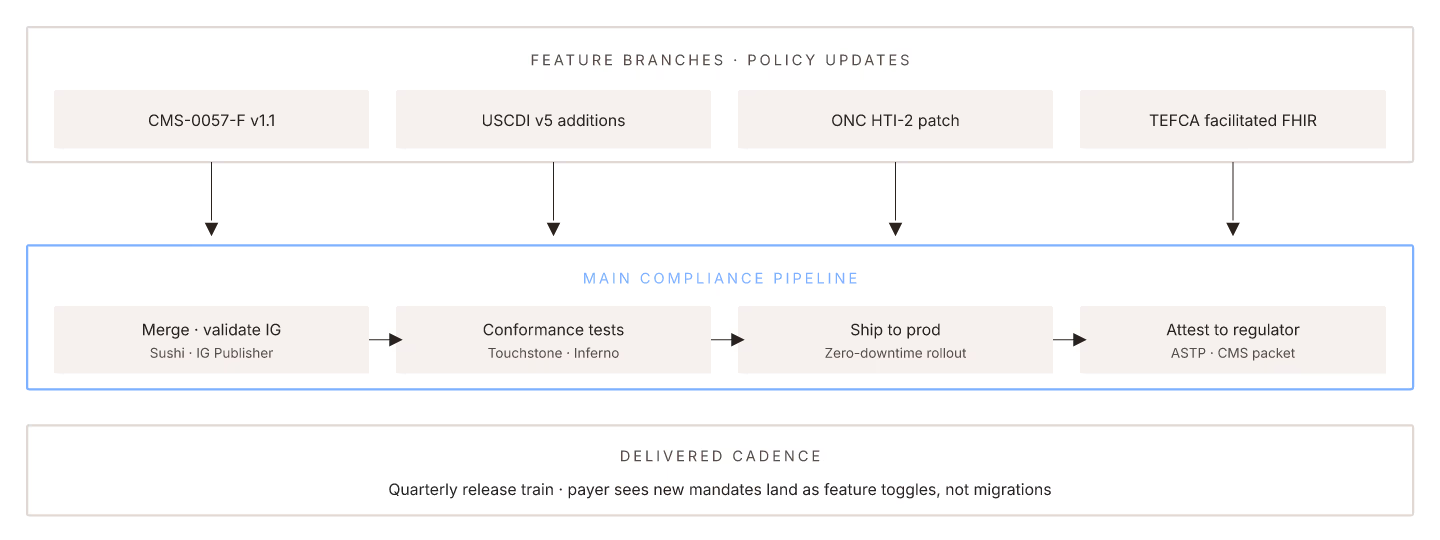
The rule is often treated as one deliverable because CMS wrote it as one document. Payer engineering teams do not have to inherit that shape. A cleaner cut is to name each requirement as a product feature that could ship on its own train:
- Patient Access improvements (adding claims, clinical, and prior auth data to the existing API).
- Provider Access API (letting a provider pull the member panel record without waiting for a fax).
- Payer-to-Payer API (moving records when a member changes plans, not four months later).
- Prior Auth API MVP (the CRD, DTR, and PAS trio hitting one narrow service line).
- Prior Auth API SLA hardening (extending to more service lines, tightening decision times).
Each of those has an owner, a metric, and a demo. None of them has to wait for the others.
Pick a Release-Train Cadence That Matches Reality
A quarterly release train is usually the sweet spot for regulated payer stacks. Faster than that and the utilization management review boards cannot keep up with policy changes. Slower than that and you end up back in the two-year plan. Every train carries some subset of the features above, gated behind flags per API.
In practice, this looks like:
- Train Q1: Patient Access expansion behind a member-cohort flag.
- Train Q2: Provider Access read endpoint, gated by contracted provider group.
- Train Q3: PA API MVP for a single service line, gated by product code.
- Train Q4: Widening the PA API to the top ten service lines and turning on SLA reporting.
The flag layer is doing real work here. It lets you cut a release without cutting the audit trail, and it lets clinical operations pull an API back if a downstream vendor breaks.
Plan Backwards-Compat and Legacy Sunset From Day One
The trap is running the new PA API next to the fax and phone workflow forever. Every quarter, a slice of provider volume should move from the legacy path to the new one, with a published deprecation date for the old surface. In the embedded compliance camp, offerings like Payerbox from Health Samurai treat CMS-0057-F as a set of APIs to layer onto an existing FHIR core rather than a separate platform to procure, which makes the coexistence phase shorter because both surfaces read from the same store.
Write the sunset schedule into the same doc as the release train. If the legacy path does not have a date, it will still be there in 2029.
The Org Chart Change Nobody Wants to Talk About
Shipping this as a product feature only works if product and engineering are actually organized around it. Some patterns that hold up:
- One product manager owns Prior Auth as a product surface, not as a project.
- One SRE rotation owns the four APIs, with a shared runbook.
- Compliance and legal review sit inside the sprint, not outside it.
- Clinical operations gets a seat on the release train, because their workflows change.
For behavioral health workflows specifically, the DTR forms will look a lot like intake forms your teams already build, and it is worth reading how open-source SDC form builders compare with EMR-native forms for behavioral health before deciding who owns the questionnaire content. Ownership questions also come up when you compare FHIR Questionnaire vs PDF intake for trauma therapy clinics, because the same authoring pipeline can feed both prior auth and clinical intake.
Who This Approach Fits
This model fits payers who already run a FHIR platform and have at least one product team comfortable with feature flags and quarterly releases. It does not fit shops that only ship on annual freezes. If your team lives closer to the freeze model, the honest answer is that CMS-0057-F will feel like a project no matter what, and the work is to shrink the freeze rather than the rule.
Sources
- Federal rule PDF, CMS, 2024 - CMS-0057-F Interoperability and Prior Authorization final rule official document with January 1, 2026 operational and January 1, 2027 API compliance dates
- Government slide deck, CMS, 2024 - CMS Interoperability and Prior Authorization Final Rule presentation (2024-03-26) covering phased API rollout (Patient Access, Provider Access, Payer-to-Payer, Prior Auth)
- HL7 IG, HL7 Da Vinci Project, 2025 - Prior Authorization Support (PAS) FHIR IG v2.1.0 — the referenced standard behind the CMS-0057-F Prior Authorization API (CRD/DTR/PAS trio)