
Medicare behavioral health billing has its own coding gravity. The CPT psychotherapy codes plus HCPCS Level II add-ons, the LCD/NCD-driven ValueSets that decide medical necessity, the HCPCS modifiers, and the constantly-updating fee schedule all have to be queryable from a single terminology layer. A FHIR terminology engine that fits this load handles all of them as first-class content, not as optional bolt-ons.
This is the five terminology engines that come up most in 2026 Medicare-facing behavioral-health stacks. For the behavioral health interoperability hub the broader catalog is one click away.
For the higher-level brief, the complete guide to FHIR terminology services for behavioral health in 2026 sets the framing.
What Medicare Billing Adds to the Brief
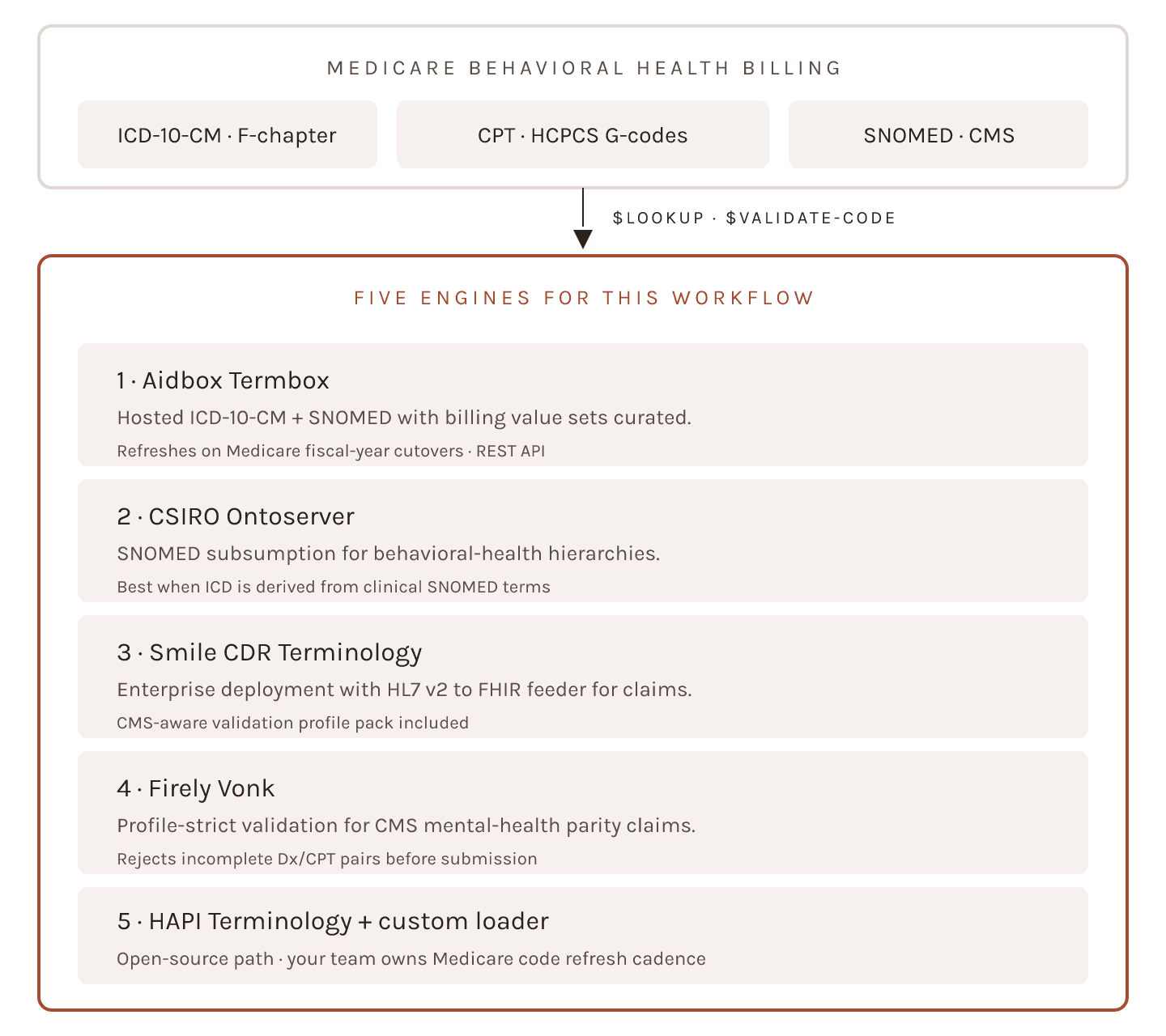
The expectations break into four pieces:
- CPT psychotherapy codes plus HCPCS Level II codes, kept current with annual revisions.
- LCD and NCD ValueSets resolvable through `$expand`, because medical necessity decisions reference them directly.
- HCPCS modifiers (the GT, 95 telehealth modifiers and their successors) attached as code properties.
- A `$translate` path between ICD-10-CM (the diagnosis side) and CPT/HCPCS (the procedure side) for cross-checks.
Engines that host CPT alone cover one corner of the load. The other three are where the integration work hides.
The 5 Engines Worth Knowing
- Termbox. A commercial terminology server with curated Medicare ValueSets, current-year CPT and HCPCS content, and a behavioral health subset readily expandable.
- Smile Digital Health Terminology. A commercial offering with strong content currency and a tight integration story for FHIR services and billing.
- Ontoserver. A commercial server widely deployed in payer and provider stacks. Strong for general terminology; LCD/NCD ValueSets layered on top through its content workflow.
- HAPI FHIR Terminology Module. The open-source workhorse. CPT, HCPCS, and LCD/NCD ValueSets are loaded as a content step; the team owns the update cadence.
- NLM Value Set Authority Center (VSAC). Not a full server, but the canonical source for many Medicare quality-reporting ValueSets. The above tools tend to import its content.
What Tips the Choice for Medicare Specifically
Three operational factors decide:
- Update cadence. CMS publishes LCD/NCD revisions on its own schedule; engines that ship updates as part of the contract reduce manual content steps.
- Cross-system translation. Programs that bill across Medicare and Medicaid (or that participate in dual-eligible programs) appreciate engines that maintain cross-walks as a service.
- Telehealth modifier handling. The post-PHE telehealth modifier picture is still evolving in 2026; engines that surface modifiers as code properties keep the chart and the bill aligned.
For the CPT-only side of psychotherapy billing, Top 6 terminology tools for CPT psychotherapy codes and time units covers the focused product list. For the hosting question (which often becomes the actual budget line for a small Medicare-participating practice), hosted vs self-hosted terminology servers for behavioral health practices walks through the deployment trade-offs.
How to Pilot Cleanly
Pick the five most-billed Medicare combinations the program uses (90837 with a depressive disorder, 90834 with a trauma-related diagnosis, +90785 add-on, a HCPCS telehealth combination, and a representative LCD-driven service). Run `$lookup` and `$expand` against each candidate engine, and check the LCD ValueSets resolve cleanly. Engines that hold up across all five on the first try are the ones worth a procurement conversation.
Sources
- CARIN BB CPT/HCPCS procedure codes - HL7 IG ValueSet, HL7 Financial Management WG, 2025
- New CPT Codes for Mental Health in 2025 - Industry reference, Medisys Data Solutions, 2025
- 2025 Mental Health CPT and ICD Code Updates - Industry reference, Ensora Health, 2025